Does your child constantly argue with you and try to negotiate? Are the “threenager” and “fournado” phases a myth?
Many parents of 3- or 4-year-olds notice that their children constantly argue, negotiate, and question the rules. Are the terrible twos just a lead-in to the threenager and fournado phase?
What are the threenager and fournado phases?
Around the age of 3 or 4, some children act like little teenagers and go through a rebellious phase. This stage of development is less well defined and researched than the terrible twos, but many children experience it. Your child may start to argue with you and question the rules on a daily basis.
These behaviours can be explained by the fact that at this age, children have much better verbal skills than before. They’re now able to verbalize their tastes, preferences, and desires. What’s more, they’ve learned how to negotiate to get what they want.
In addition, around the age of 3 or 4, children start to crave more autonomy. They want to experiment with as little support as possible. However, because their brain is still developing, they continue to struggle with emotional regulation and impulse control.
At this age, they also have trouble accepting boundaries because they want to have more freedom and control. This can lead to frustration and oppositional behaviours.
How to manage a rebellious toddler
At this age, your child needs help to learn how to assert themself, follow rules, and regulate their emotions. Here are few things you can do to manage your rebellious 3- or 4-year-old.
They want to do things all by themself
Your child wants to be more autonomous. They’re eager to do things by themself, but still need your help with certain tasks (e.g., getting dressed). This can lead to frustration or even tantrums.
How should you react?
Get down to eye level with your child when speaking to them and make eye contact to get their attention.
- Give them age-appropriate responsibilities to satisfy their need for independence. For example, ask them to help you set the table or measure out the dry ingredients for a recipe.
- Give them guidance when they need help, instead of doing things for them.
- Whenever possible, give your child more time to do things on their own, without you having to rush him.
- In other situations, you can split the task with your child. For example, you can say: “Do you want to put on your pants or your sweater by yourself today? I’ll help you put on the other one.”
They don’t always follow rules
Your child understands rules and instructions, but doesn’t always follow them. They may want to change the rules of a game, especially if they’re losing, or keep playing when you’ve asked them to tidy up.
How should you react?
- Repeat the rules as many times as necessary. Your child is still struggling with impulse control. That’s why they may sometimes break a rule—they simply can’t help themself.
- Explain why rules are necessary when they question them. Understanding the reasons behind rules may encourage your child to follow them. For example, you could tell them that you don’t want them to run into the street to get their ball because they could get hurt.
They try to negotiate or test boundaries
How to help your toddler get control of their emotions during a tantrum.
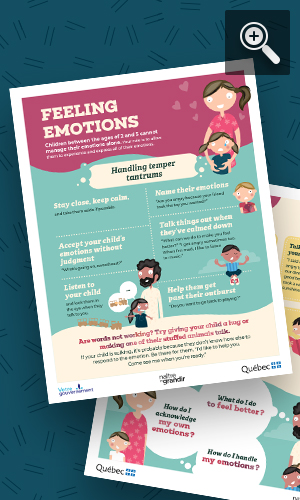
For example, your child might refuse to put their toys away, saying they’re going to play with them later anyway. Or, they might sulk and refuse to take their bath when you ask them to.
How should you react?
- Reiterate the rules and don’t give in to your child’s behaviour. Your little one will understand that the rules are important to you. Plus, knowing that the rules never change will actually reassure them.
- But take the time to validate and name your child’s feelings. For example, you can say, “I can see you want to keep playing instead of taking your bath, and that makes sense. But it’s getting late, and you can play again tomorrow.” Just feeling heard and understood can encourage them to cooperate more and argue less.
- Turn your instructions into a game to encourage your child to participate. For example, you can say, “I’ll help you put away your toys, then you can pick whether we sing or dance to the bathroom for bath time.”
- Give them options. For instance, you can say: “Which pyjamas would you like to wear? The blue ones or the green ones?” Giving them choices makes them feel like they have some control. It doesn’t work every time, but it can lead to more cooperation and less arguing.
If you’d like some tips to help you deal with your child’s tantrums, check out our fact sheet on the topic.
When does this phase end?
These behaviours usually ease up around the age of 5 or 6, when your child understands a little better that rules are necessary to ensure things go smoothly, whether at home, at daycare, or at school.
Be patient, because how you respond to your child’s behaviour can go a long way in helping them develop their social skills.
Little by little, your child is beginning to do the following:
- Understand that rules are essential to ensure everyone feels respected
- Listen to adults and participate in family and social life
- Be more independent and do more things without help
- Speak calmly instead of shouting when expressing a need or desire
Never use physical punishmentEven when kids misbehave, physical punishment (hitting, shaking, shoving, etc.) is not an effective form of discipline. In fact, it has a negative effect on their psychological and social development. |
Things to keep in mind
-
Around the age of 3 or 4, children often start to negotiate and question the rules.
-
Responding in a consistent manner helps reassure them.
-
With your help, your child will find positive ways to assert themself.
| Scientific review: Marie-Hélène Chalifour, psychoeducator
Research and copywriting:The Naître et grandir team
Updated: November 2025
|
Photo: GettyImages/Juanmonino
Resources and references-
Bilodeau, Mélanie. Soyez l’expert de votre bébé. Quebec City, Éditions Midi trente, 2022, 240 pp.
-
Bourque, Solène. Les grandes émotions des tout-petits: comprendre et soutenir les apprentissages émotionnels chez les 2 à 6 ans. Éditions Midi trente, 2020, 144 pp.
-
Couturier, Stéphanie. Aider son enfant à s’apaiser sans cris ni punitions. Éditions Marabout, 2022, 159 pp.
-
Doyon, Nancy. Parent, gros bon sens. Éditions Midi trente, 2017, 224 pp.
-
Filliozat, Isabelle. Éduquer : tout ce qu’il faut savoir. Éditions Robert Laffont, 2024, 368 pp.
-
Hamel, Sarah. Le Ti-pou d’Amérique : mieux le comprendre pour mieux intervenir. Laval, Guy Saint-Jean Éditeur, 2022, 256 pp.
-
Racine, Brigitte. Le respect: une valeur pour la vie. Éditions du CHU Sainte-Justine, 2016, 236 pp.
Books for kids -
D’Allancé, Mireille. What a Tantrum! Corimbo, 2003, 30 pp.
-
Bourque, Solène. Mini Loup vit un tourbillon d’émotions. Éditions Midi trente, 2017, 48 pp.
-
Desputeaux, Hélène. Mella : une mauvaise journée. desputeaux + aubin, 2008, 12 pp.
-
Gaudrat, Marie-Agnès. Adélidélo dompteuse de colère. Illustrated by Fred Benaglia, Bayard Jeunesse, 2021, 26 pp.
-
Hamel, Sarah. Ti-pou est très fâché! Saint-Jean Éditeur, 2024, 32 pp.
-
Latulippe, Martine, and Nathalie Parent. La colère de Fabien. Mammouth rose, June 2020, 32 pp.
-
Laurans, Camille. La colère. Milan jeunesse, 2020, 29 pp.
-
Llenas, Anna. The Color Monster: A Story about Emotions. Little, Brown and Company, 2018, 40 pp.
-
Paruit, Marie. Je suis en colère. Larousse Jeunesse, “La météo des humeurs” series, 2020, 10 pp.
-
Percival, Tom. Ravi’s Roar. HarperCollins Canada, 2019, 32 pp.
|